
FX Risk Management
When Markets Are Volatile, FX Strategy Matters More — Not Less
Periods of global uncertainty don’t pause international business. They make the cost of an unmanaged currency position much higher — and the case for a deliberate FX strategy much clearer.
It’s tempting, when markets are moving sharply, to put currency management in the “deal with it later” pile. You’re already tracking supply chain disruptions, repricing contracts, managing supplier relationships, and fielding questions from stakeholders. FX feels like one more variable you can’t control.
That instinct is understandable — and it’s also precisely backwards.
Volatile markets are when unmanaged FX exposure causes the most damage. A 2–3% currency swing in a stable quarter is an irritant. The same swing, compounded over multiple transactions during a period when major currency pairs are moving 8–10% over weeks, can eliminate a quarter’s margin in a business that thought it was insulated.
This article is for finance directors, CFOs, and business owners at companies that trade internationally — whether you’re a Florida-based company with overseas suppliers or revenues, or a foreign company with a US operation. It’s about what “being strategic about FX” actually means in practice, and why the current environment makes that conversation more urgent than usual.
1. What’s actually happening in currency markets right now
2026 has been a volatile year for currencies. The US dollar, long treated as a safe haven, has faced an unusual combination of pressures: tariff uncertainty, rising Treasury yields, shifting investor confidence in US exceptionalism, and sustained geopolitical tension across multiple theatres. The result is a market in which major pairs — EUR/USD, GBP/USD, USD/BRL, USD/MXN — have been moving more sharply, and less predictably, than in recent years.
This isn’t a temporary blip. The structural drivers of FX volatility — monetary policy divergence between major central banks, the US–China trade dynamic, and geopolitical instability affecting commodity prices and risk appetite — are features of the current environment, not bugs. Businesses that built their financial planning around a relatively stable dollar are now operating in a fundamentally different context. The Bank for International Settlements estimates daily global FX market turnover at over $7.5 trillion — a market that moves continuously and responds to macro developments faster than most businesses can react.
For companies with international revenues or costs, this environment has a direct P&L impact. Whether you’re paying overseas suppliers in euros, receiving payment from UK clients in sterling, repatriating profits from a US subsidiary, or paying manufacturing costs in Mexican pesos, the rate you transact at — and whether you’ve done anything to protect it — determines a material part of your financial outcome for the year.
2. The hidden cost most businesses are still ignoring
Before getting to strategy, it’s worth being clear about the baseline problem — because many businesses are paying more than they realise just through the mechanics of how they currently move money.
When you send or receive an international wire through a US retail bank, two costs apply. The first is the wire fee itself — typically $25–$50 per outgoing transaction, visible on your statement. The second is the FX spread: the gap between the rate the bank applies and the actual mid-market rate at that moment. This spread is typically 2–4% and does not appear as a line item. It’s embedded in the exchange rate you’re quoted, which makes it invisible to most finance teams unless they’re actively benchmarking.
This cost exists in stable markets. In volatile markets, the problem compounds. When rates are moving sharply, the spread widens. Execution timing — whether you convert on a given Tuesday or the following Monday — can mean a difference of several percentage points on a large transaction. Businesses without a deliberate approach to this are making large financial decisions by default.
3. Understanding your FX exposure — the three types
FX exposure isn’t one thing. Understanding which type applies to your business determines which tools are relevant and what a proportionate response looks like.
Transaction exposure
This is the most straightforward form: the risk that the exchange rate will move between when you agree a transaction (a sale, a purchase, a contract) and when the payment actually settles. If you quote a UK client in dollars, agree a price today, and collect payment in 60 days, a strengthening pound over that period means you receive less in sterling terms than you planned for. Businesses with predictable, contractual payment flows — exporters, importers, companies with recurring overseas invoices — face transaction exposure on every deal.
Translation exposure
This affects companies with overseas subsidiaries or operations. When you consolidate your financial statements, assets, liabilities, revenues, and costs held in a foreign currency need to be translated into your reporting currency. A US company with a UK subsidiary will see the sterling value of that subsidiary fluctuate on the group balance sheet as GBP/USD moves — even if the underlying business is performing consistently. Translation exposure doesn’t necessarily affect cash flow directly, but it affects reported earnings and net asset values, which matters for lenders, investors, and board reporting.
Economic (or operating) exposure
The subtlest and often the most strategically significant. This is the impact of currency movements on your competitive position and long-term cash flow — not just on specific transactions. If your competitors manufacture in a country whose currency weakens significantly against the dollar, they can undercut your pricing without changing their cost base. If your US revenues are growing but the dollar weakens against your home currency, your profits look worse at home even though the business is performing well in the US. Economic exposure is harder to hedge than transaction exposure, but it should inform pricing strategy, supplier diversification, and long-term business planning.
4. The tools available — and what each one does
FX risk management is often presented as something only large corporates with treasury departments can access. That’s no longer true. The tools available to mid-sized businesses have expanded significantly, and a specialist payments provider can implement straightforward strategies without requiring a team of treasury analysts.
Spot transactions
The default: convert at the rate available today, settle within two business days. Appropriate for immediate needs with no forward visibility. The risk is that you’re fully exposed to wherever rates happen to be at the moment you need to convert. In a volatile market, this is a meaningful gamble on every transaction.
Forward contracts
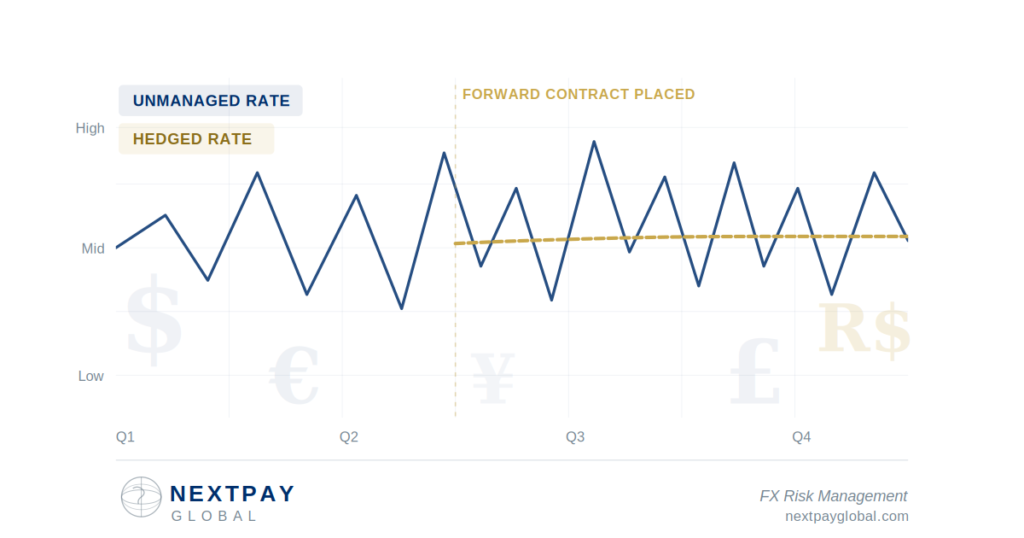
A forward contract fixes an exchange rate today for a transaction that will happen at a specified date in the future — typically anywhere from one week to two years out. You agree the rate now; the transaction settles later at that rate regardless of what the market does in between.
For businesses with predictable cash flows — a manufacturer that buys from European suppliers on 90-day payment terms, or a company that invoices US clients in dollars and repatriates profits quarterly — forward contracts eliminate rate uncertainty from known transactions. You can invoice, price, and plan with certainty, because the rate is locked.
Forwards don’t require an upfront premium payment in most cases (unlike options), which makes them accessible and practical for businesses of most sizes.
Market orders (limit and stop-loss)
Rather than converting at the current spot rate, a limit order instructs your provider to execute the transaction automatically when the rate reaches a target level you specify. A stop-loss order triggers if the rate moves against you to a predefined point — capping your downside. These are useful for businesses that have flexibility on timing and want to optimise execution without having to monitor rates constantly.
Multi-currency accounts
Holding balances in multiple currencies — rather than converting everything immediately — gives you flexibility to pay in local currency without incurring a conversion on every transaction, and to time conversions strategically rather than being forced to convert at the moment a payment arrives or is due. Multi-currency accounts are now accessible through specialist payments providers and are particularly useful for companies with regular flows in several currencies.
| Tool | Best for | What it doesn’t do |
|---|---|---|
| Spot transaction | Immediate, one-off needs; small amounts | Provides no rate certainty; fully exposed to market |
| Forward contract | Predictable future payments; invoice-based businesses | Doesn’t allow you to benefit if rate improves beyond the locked level |
| Limit order | Opportunistic conversion at a target rate | Not guaranteed to execute; rate may not reach your target |
| Stop-loss order | Capping downside on a known exposure | Doesn’t improve your outcome if rate moves in your favour |
| Multi-currency account | Regular flows in multiple currencies; strategic timing | Doesn’t eliminate rate risk — it defers the conversion decision |
5. Why businesses avoid FX management (and why those reasons don’t hold up)
In practice, most small and mid-sized businesses with international exposure don’t have a deliberate FX strategy. The reasons they give are consistent — and consistently fall apart under examination.
“We’re not big enough for this to matter”
The FX spread applies at every transaction size. A business moving $300,000 per year across currencies faces $6,000–$12,000 in spread costs at typical retail bank rates — money that goes directly off the bottom line. A single forward contract on a predictable quarterly payment doesn’t require a treasury team; it requires a ten-minute conversation with a specialist provider. The threshold for FX management to be worthwhile is much lower than most businesses assume.
“We just pass the FX risk on to our customers”
Many businesses invoice in their home currency and assume that the FX risk is now the customer’s problem. This is a reasonable approach in a stable rate environment. In a volatile one, it puts you at a competitive disadvantage: clients who can get the same product or service at a price denominated in their own currency — or from a competitor who has absorbed the FX cost — have a reason to look elsewhere. Pricing in local currency is a competitive tool as much as it is an exposure decision.
“We’ll deal with it when it becomes a problem”
This is the most expensive approach, because FX problems tend to be visible only in retrospect — when the annual accounts are prepared and the margin erosion is already baked in. The time to put a strategy in place is before you need it, not during a period of peak volatility when rates are moving against you and your options are narrower.
“FX hedging is complicated and risky”
Some FX instruments are complex and carry their own risks — options strategies, cross-currency swaps, and exotic derivatives can amplify exposure if misapplied. But the tools most appropriate for businesses of this size — forward contracts, limit orders, multi-currency accounts — are straightforward, transparent, and don’t introduce new risks. They reduce uncertainty; they don’t create it. The confusion between “sophisticated treasury strategy” and “basic FX management” leads many businesses to avoid both when only the former requires caution.
6. Building a practical FX strategy without a treasury department
For the majority of businesses reading this, “FX strategy” doesn’t mean building an in-house risk management function. It means a small number of deliberate decisions, applied consistently, that remove the largest and most avoidable risks from your cross-border transactions.
Step 1: Map your exposure
List every currency you pay or receive in over a rolling 12-month period. Quantify the approximate volumes. Identify which flows are predictable (recurring supplier payments, contracted revenue) and which are variable. This mapping — which most businesses haven’t done — is the foundation for every subsequent decision.
Step 2: Separate the spread problem from the risk management problem
These are two distinct issues that are often conflated. The spread problem is about what you’re paying every time you convert — regardless of rate direction. Retail banks typically apply spreads that are not disclosed as fees and are rarely benchmarked by the businesses paying them. A specialist cross-border payments provider can tell you exactly what rate you’re receiving, how it compares to the market, and what you’re paying in real terms on each transaction. The risk management problem is separate: it’s about protecting against rate movements on future transactions. Both conversations are worth having, and neither requires a large or complex business to justify.
Step 3: Hedge what you can predict; leave flexibility for what you can’t
A common misconception is that effective FX management means hedging everything. It doesn’t. It means hedging the exposures that are large, predictable, and where rate certainty has clear business value — and accepting spot risk on smaller, unpredictable, or immaterial flows. A practical starting point: identify your three largest recurring cross-border payment types and ask whether forward contracts would meaningfully improve your budget certainty on those specific flows.
Step 4: Make conversion timing a conscious decision
For businesses using multi-currency accounts, the decision of when to convert a held balance into your home currency should be deliberate — not an automatic default. This doesn’t require constant rate monitoring; it can be as simple as setting target rates with your provider and letting limit orders do the execution automatically. But it does require acknowledging that the timing decision has financial consequences.
Step 5: Review regularly
FX strategy isn’t a one-time configuration. Exchange rate environments change, your business mix changes, and the relevance of hedging tools changes with them. A quarterly review with your payments provider — even a brief one — keeps the strategy aligned with the current reality.
7. The right questions to ask your payments provider
If you’re currently using a retail bank for international payments — or a provider you haven’t scrutinised closely — these questions will tell you quickly whether your current arrangement is working for you.
- What rate are you applying to this conversion, and how does it compare to the mid-market rate right now? Any provider should be able to answer this clearly. Vague responses or difficulty making the comparison are telling.
- Do you offer forward contracts? What are your terms, margins, and minimum transaction sizes? Some providers advertise FX services but offer only spot conversion in practice.
- Can I hold balances in multiple currencies? What currencies are available? Multi-currency accounts vary considerably between providers in terms of which currencies are supported and how balances are held.
- How do you settle international payments — through correspondent banking chains or local payment rails? Local payment rails typically mean faster settlement, lower intermediary fees, and more predictable delivery timelines.
- What reporting do you provide on my FX transactions? Good providers offer clear transaction records that make it straightforward to reconcile what you paid, what rate applied, and what the mid-market rate was at that time.
The answers to these questions determine whether your current provider is a genuine cross-border payments partner or simply a conduit for transactions — one whose spread costs may be significantly higher than they need to be.
Find out what your international payments are actually costing you
Nextpay Global’s free FX Review benchmarks your current rates against the market for your specific currency corridors and volumes — and identifies where savings are available. No commitment required.
Book a Free FX ReviewFinal thoughts
Volatile markets don’t change the fundamentals of FX management — they amplify the consequences of getting it wrong. The businesses that come out of periods of sharp currency movement with their margins intact are not necessarily the ones that predicted the moves correctly. They’re the ones that had a strategy in place before the volatility arrived: clear visibility on their exposure, competitive rates on their transactions, and appropriate protection on their largest predictable flows.
None of that requires a treasury department or sophisticated financial instruments. It requires a deliberate approach to something most businesses are currently handling by default.
The current environment is an argument for urgency — but the right response to urgency in FX isn’t to make reactive decisions. It’s to put a framework in place now, so that the next period of volatility is a managed situation rather than an unwelcome surprise.
Disclaimer: This article is for general informational purposes only and does not constitute financial, investment, or treasury advice. Currency markets are inherently unpredictable and past performance is not indicative of future results. All FX management decisions should be made in consultation with qualified financial professionals who understand your specific business circumstances.