
Webinar Recap · FX Strategy
Stop Losing Money to Hidden Foreign Exchange Costs: What We Covered at Our Florida Trade Webinar
A recap of our August 6 session on multi-currency accounts, sector-specific FX strategy, and the questions every finance leader should ask before choosing a payments partner.

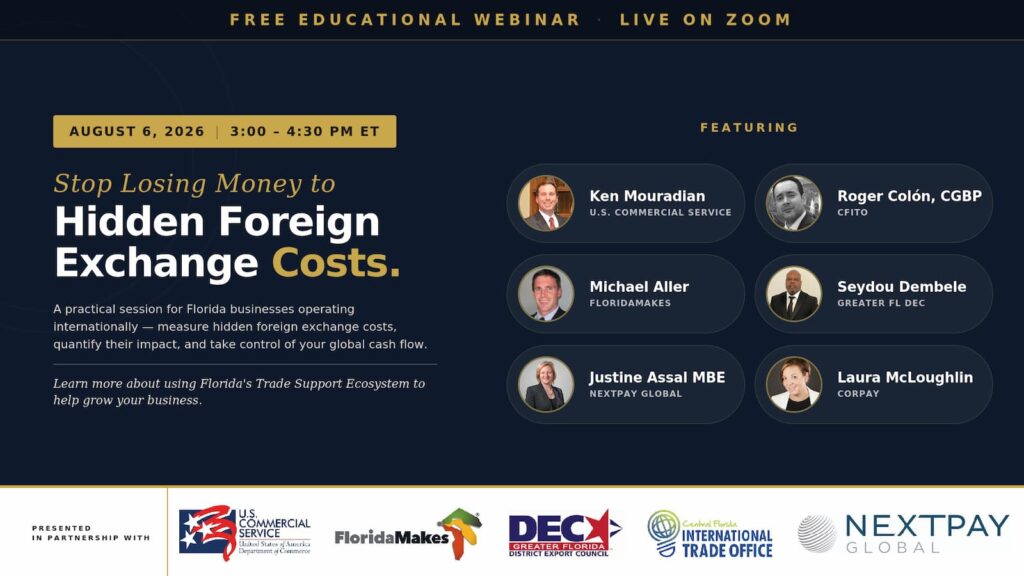
On August 6, Nextpay Global joined the U.S. Commercial Service, FloridaMakes, the Greater Florida District Export Council, the Central Florida International Trade Office, and Corpay for a live session built for one purpose: helping Florida businesses see the foreign exchange costs that never show up as a line item on a bank statement.
The premise is simple. A Florida business moving $500,000 a year across currencies typically loses somewhere between $10,000 and $20,000 to foreign exchange spreads that never appear as a fee anywhere in its accounts. That gap grows in direct proportion to volume, and most finance teams don’t have a clear way to see it, let alone manage it.
Below is a recap of what the panel covered, organized the same way the session was: multi-currency accounts, sector-specific strategy, building a payments approach that scales with the business, and the questions worth asking before you choose a banking or payments partner.
Multi-currency accounts: the most underused lever
As businesses expand internationally, foreign exchange becomes one of the biggest hidden costs on the books — hidden because most finance teams never see it as a line item, they simply watch it erode margin. The panel walked through the challenges that show up repeatedly: multiple currency conversions happening on a single transaction, unfavorable rates from automatic conversions, limited visibility into global cash balances, delayed supplier payments, and difficulty forecasting FX exposure in the first place.
The root cause is usually the same: a payment arrives, it gets converted automatically into the home currency, and then it gets converted again when it’s time to pay a supplier in a different currency. Each conversion carries a cost. A multi-currency account addresses this directly — it lets a business hold balances in multiple currencies without converting immediately, so the decision about when (and whether) to convert stays in the business’s hands rather than happening by default.
In practice, that means collecting customer payments in their local currency, holding those proceeds until exchange rates move favorably, and paying suppliers directly out of that same currency — no unnecessary round-trip conversion. Beyond the direct FX savings, the panel pointed to faster international settlement, cleaner reconciliation, a better experience for customers and suppliers paid in their own currency, lower banking fees, and clearer treasury visibility overall.
A worked example: one conversion versus two
The panel illustrated the point with a straightforward scenario: a U.S. manufacturer sells products in Europe, and a customer pays €250,000 for goods. What happens next depends entirely on account structure.
| Without a multi-currency account | With a multi-currency account |
|---|---|
| Customer pays €250,000 | Customer pays €250,000 |
| Bank converts the full amount to USD immediately | Funds remain in EUR |
| Company later needs to pay a German supplier, so USD converts back to EUR | Company pays its European suppliers directly out of the EUR balance |
| Result: two FX conversions, two sets of fees and spread | Result: one conversion — or potentially none — only on excess funds, only when it makes sense |
Sector-specific strategy: manufacturing, exporters, life sciences
International payments aren’t one-size-fits-all. An effective strategy has to reflect a company’s operational realities, regulatory requirements, and supplier expectations — so the panel broke down what that looks like across three sectors.
Manufacturing
| Key challenges | Strategy | Success metrics |
|---|---|---|
|
|
|
Exporters
| Key challenge | Strategy | Success metrics |
|---|---|---|
| Managing the currency risk between when a customer pays and when that revenue is actually recognized, across multiple countries |
|
|
Life sciences
| Key challenges | Strategy | Success metrics |
|---|---|---|
|
|
|
Building a payments strategy that scales with you
A payments strategy isn’t static — it should evolve as the business grows. The panel framed that evolution as four stages, from an emerging business doing $100,000 a year in international payments up to an enterprise moving $500 million or more.
| Stage | Annual volume | Priorities | Supporting tools |
|---|---|---|---|
| 1. Emerging Global Business | $100K–$1M | Reduce payment fees, improve FX visibility, simplify collections, establish basic payment policies | Multi-currency accounts, online payment platform, basic FX reporting, standard approval workflows |
| 2. Growing International Company | $1M–$25M | Improve cash visibility, reduce manual work, automate approvals, centralize treasury functions | ERP integration, batch payments, multi-entity support, currency forecasting, payment automation |
| 3. Global Enterprise | $25M–$100M | Liquidity optimization, treasury visibility, risk management, centralized reporting | FX hedging programs, global liquidity management, payment factory model, automated reconciliation, advanced analytics |
| 4. Enterprise Scale | $100M–$500M+ | Optimize working capital, reduce operational risk, strengthen controls, support global growth | Global cash positioning, API connectivity, virtual accounts, payment orchestration, treasury management system integration |
Wherever a business sits on that spectrum, the point the panel kept returning to was consistency: infrastructure should match the current stage, not lag a step behind it.
Seven questions to ask a banking or payments partner
Choosing a payments partner should involve a lot more than comparing transaction fees. The panel closed the strategy portion of the session with seven questions every finance leader should be asking up front.
- How many currencies can we hold and transact in? Can funds be held without immediate conversion, and are local receiving accounts available?
- What exchange rates do you provide? Is pricing transparent, how are FX spreads determined, and can rates be locked in advance?
- What payment methods are supported? SWIFT, SEPA, Faster Payments, local ACH equivalents, and real-time payment networks.
- How does the platform integrate with our ERP? Look for proven integrations with SAP, Oracle, Microsoft Dynamics, NetSuite, and Sage.
- What controls exist for fraud prevention? Dual approvals, user permissions, payment limits, positive pay, multi-factor authentication, real-time monitoring.
- How is compliance managed? AML and sanctions screening, KYC, tax documentation, regulatory reporting, and data security certifications.
- Can the solution scale with the business? Multi-entity capability, global expansion support, treasury services, API connectivity, and dedicated client support.
Asking these questions before signing with a partner is far easier than switching partners later, right when a growing business can least afford the disruption.
The core takeaway
Cross-border payments are a strategic lever, not just a way to move money. Businesses that put multi-currency capabilities to work, tailor their payment approach to their sector, build infrastructure that matches their current stage, and choose partners based on long-term capability rather than headline fees are better positioned to operate efficiently in a global economy. Every international payment is a chance to optimize working capital, reduce risk, and build a real advantage over competitors still treating FX as an afterthought.
Watch the full session
The complete recording is below, including the live Q&A — free to watch, no registration required.
Watch directly on YouTube and subscribe for future sessions.
Ready for your own FX review?
Nextpay Global is powered by Corpay (NYSE: CPAY), supporting 22,000+ clients across 200+ countries with exchange capability in 145+ currencies. We offer a free, no-obligation FX Review that benchmarks your current international payment costs and identifies where savings are available.
Book a Free FX ReviewContinue exploring FX strategy
About this recap: This post summarizes a live educational session presented by Nextpay Global in partnership with the U.S. Commercial Service, FloridaMakes, the Greater Florida District Export Council, and the Central Florida International Trade Office, with Corpay. It is intended for general informational purposes and does not constitute financial or tax advice.